
Looking to strengthen your organisation’s print security strategy?
New Zealand organisations have spent years strengthening their defences against cyberattacks — locking down networks, securing endpoints, and moving workloads to the cloud. But new independent research suggests one part of the IT environment hasn’t kept pace: print.
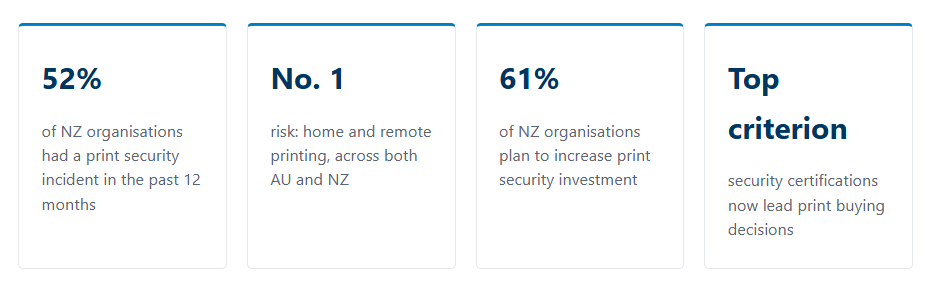
According to new research commissioned by Konica Minolta and conducted by global analyst firm Omdia, 52% of New Zealand organisations experienced a print-related security incident in the past 12 months. That’s more than one in two organisations, despite continued investment in cybersecurity elsewhere.
The findings are part of The Security Mandate: Protecting Modern Print, the first report in a three-part digital workplace research series exploring how organisations across Australia and New Zealand are approaching print security, information management and cloud print adoption. The research surveyed 400 senior IT decision-makers across both markets.
Why print security is slipping through the cracks
Print devices have quietly become part of the connected IT ecosystem — linked to networks, cloud platforms, business applications and identity systems. Yet many organisations still manage them as standalone office equipment rather than as part of a broader cybersecurity strategy.
The research points to a few key reasons why gaps are emerging locally:
- Hybrid work has expanded the risk surface. Home and remote printing has introduced new vulnerabilities that many organisations haven’t fully addressed.
- Secure release printing plays a critical role in modern print governance. Implementing secure release printing helps organisations reduce the risk of sensitive documents being left unattended at print devices and enhances overall information security.
- Investment is coming, but slowly. The 61% of New Zealand organisations expect to increase investment in print security over the next 12 months — a sign the risk is being recognised, even if action hasn’t fully caught up.
Security is now a buying decision, not an afterthought
One of the more telling findings is how much weight security now carries when organisations choose print technology. Security certifications and controls have become a top criterion in vendor selection — a clear signal that print can no longer be treated as a low-priority corner of the IT estate.
What New Zealand organisations can do next
The good news is that closing these gaps doesn’t necessarily mean ripping out existing infrastructure. The report points to a handful of practical, achievable steps:
- Reviewing and tightening remote and home printing policies
- Implementing secure release printing so jobs aren’t left exposed at the device
- Strengthening and standardising authentication across sites
- Bringing print security into the same governance framework as the rest of the cybersecurity strategy
EXPLORE THE RESEARCH
The Security Mandate: Protecting Modern Print breaks down the data in more detail, including the specific vulnerabilities, governance gaps and investment trends shaping print security across Australia and New Zealand — and what organisations can do to close the gap.
Download the Report Here
You can also read the full media release, New Research Reveals Print Security Gaps Across Australian and New Zealand Organisations, for the complete findings and commentary from Konica Minolta and Omdia.